

20 Fun Phonemic Awareness Activities and Resources to Build Important Early Literacy Skills

Phonemic awareness is an important skill for children to develop before learning to read and can be taught through fun daily activities.
Understanding that spoken words are made up of individual sounds (phonemes) is one of the five essential components of learning to read. Research suggests that children who have developed their phonemic awareness skills will have a much easier time decoding and reading printed words. Parents can play a significant role in helping their child develop these important auditory and oral skills by introducing a variety of fun phonemic awareness activities into the daily routine.
Below are 20 hands-on phonemic awareness activities you can play with your child, plus expert resources to support systematic skill development.
Contents
What is phonemic awareness?
Phonemic awareness is the ability to hear, identify and manipulate individual sounds (phonemes) in spoken words. For example, in the word 'cat', there are three phonemes: /k/ /a/ /t/. It's an auditory and oral skill – no letters or printed words are required.
Why is phonemic awareness important?
Phonemic awareness supports later decoding (sounding out words) and encoding (spelling). When children can correctly and consistently hear individual sounds in words, they are better prepared to start learning which letters represent those sounds.
According to the Science of Reading, children need explicit instruction within a systematic structure that includes five essential components:
Phonemic awareness
Phonics
Fluency
Vocabulary
Reading comprehension.
For example:
A child develops phonemic awareness – they can hear and manipulate individual sounds
They learn that those sounds map to letters (grapheme-phoneme correspondence)
That mapping is phonics.
Children don't need full phonemic awareness mastery before phonics begins – they need enough foundational awareness so that letter-sound instruction will make sense to them.
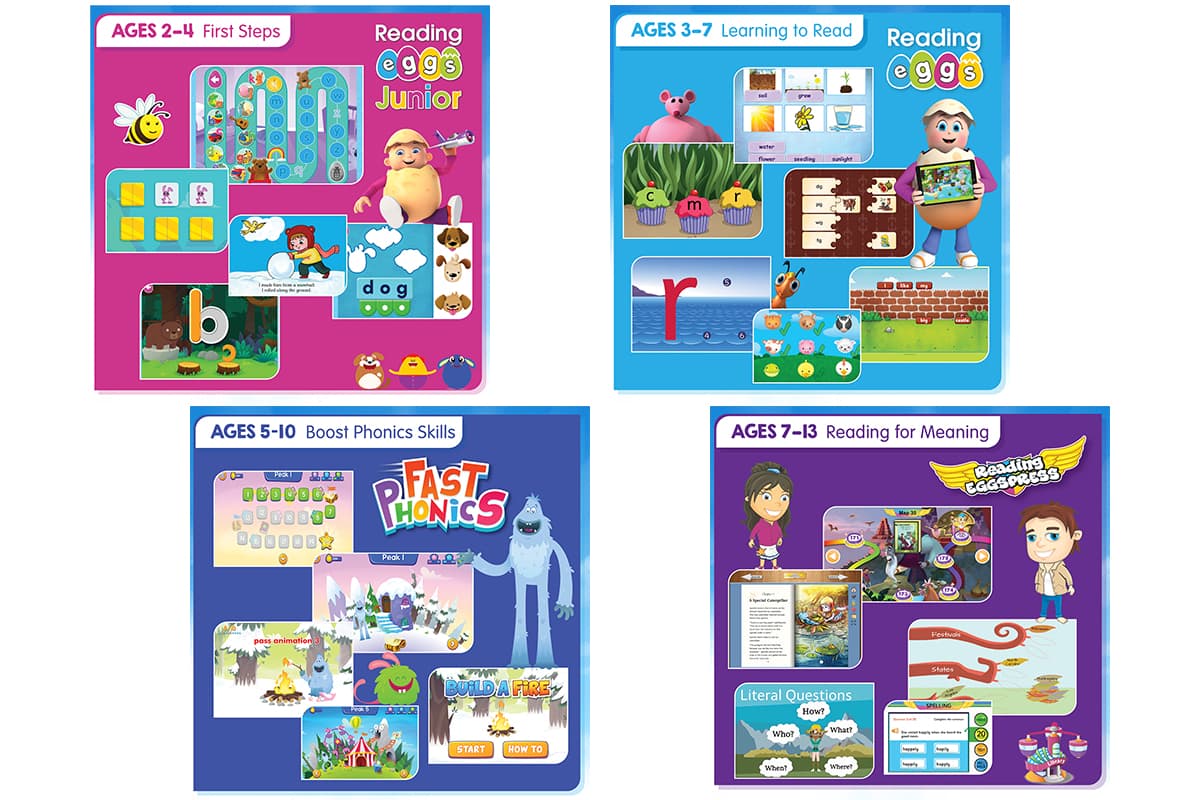
The Reading Eggs suite of programs (for ages 2–13) makes it easy and fun for children to go from phonological awareness through to mastering phonics, reading fluently and building advanced comprehension skills.
The core phonemic awareness skills
Phonemic awareness develops in a predictable sequence from simple to complex. As skills are mastered, instruction moves to more difficult skills incrementally.
Understanding this progression helps you meet your child where they are and practise the right skills at the right time without over-challenging them.
Isolation (foundational) – Identifying individual sounds in words
Blending – Combining separate sounds to make words
Segmentation – Breaking words into individual sounds
Manipulation – Adding, removing or changing a sound to make a new word.
Preparing for phonemic awareness (ages 3–4)
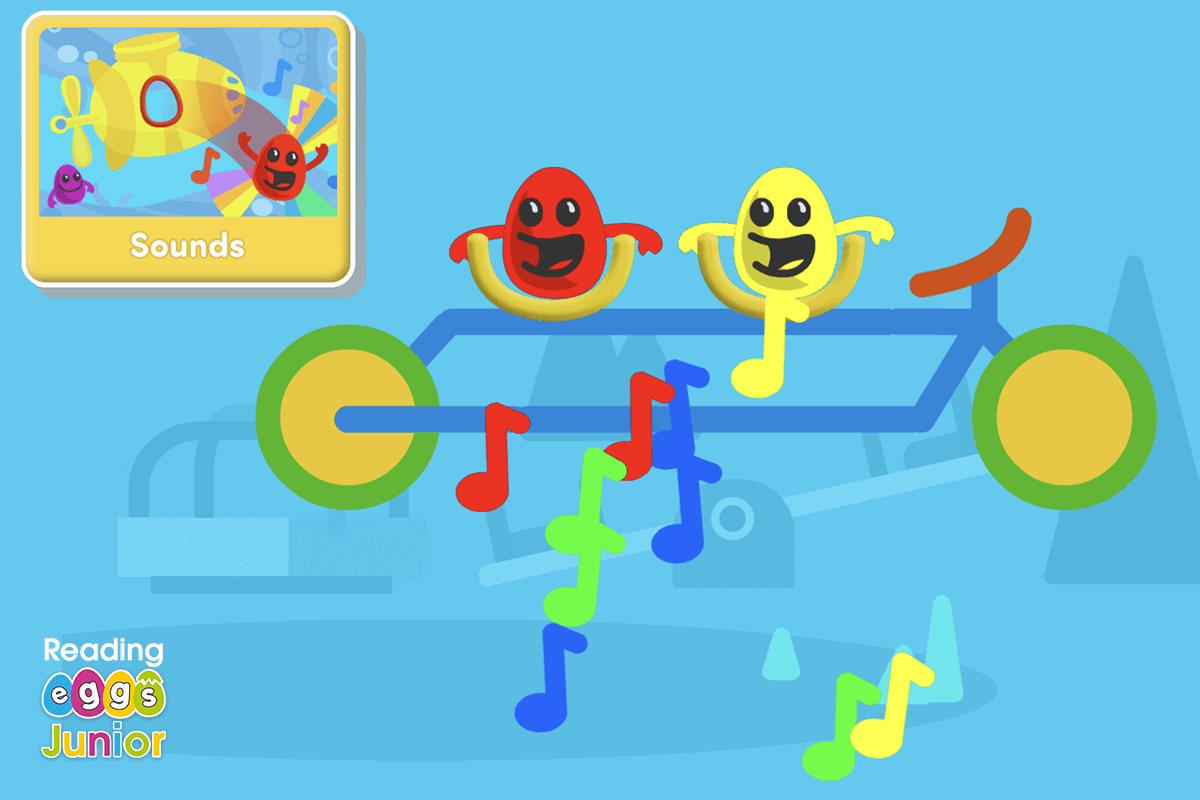
The Sounds activity in Reading Eggs Junior helps children refine their auditory discrimination skills as they listen and match sounds. Strong listening skills are fundamental to developing phonemic awareness. Your child can play this fun activity and hundreds of others free for 30 days.
Before children start tuning in to the sounds of individual phonemes, they need foundational phonological awareness skills and be able to play with the larger sounds in spoken language (rhymes, rhythm and syllables).
For children ages 3–4, start with these preparatory activities:
Nursery rhymes
Nursery rhymes are one of the most powerful – and most underestimated – tools in early literacy. When children hear Humpty Dumpty, Jack and Jill, or Hickory Dickory Dock repeatedly, they're not just learning a fun poem. They're internalising the rhythmic and sound patterns of language: that words have beats, that some words share endings and that language can be played with.
Repetition is the key ingredient – the more times a child hears the same rhyme, the more their brain begins to notice its sound structure.
Recite rhymes in the car, at bath time and at bedtime. The sillier and more rhythmic, the better.
Rhyming games
Introduce simple rhyming games that prompt your child to notice rhymes and then produce rhymes.
Start with recognition: "Do cat and hat rhyme – do they sound the same at the end?" “What about cat and dog?”
When your child answers questions like these easily, move to producing rhymes: "What else rhymes with cat?"
Accept nonsense words – even Dr Seuss made up nonsense words to create a rhyme – because generating any rhyme, real or invented, shows genuine phonological awareness.
Picture-based rhyming card games work beautifully at this age: lay out pairs of rhyming pictures and ask your child to find the matches.
Keep sessions short – five minutes of engaged rhyming play is worth more than twenty minutes of reluctant drilling.
Syllable clapping
Syllable awareness – the ability to hear the 'beats' inside a word – is a critical bridge between hearing whole words and hearing individual sounds.
Syllable clapping makes it physical and fun. Say a word together, then clap once for each syllable: "ba-na-na" (three claps), "dog" (one clap), "flow-er" (two claps).
Vary the movement to keep it engaging – try stomping, jumping, tapping the table or banging a drum.
Use your child's name, family members' names and favourite foods, since familiar words are easiest to segment first.
Once your child can clap syllables reliably, notices when two or more words end with the same sound and can produce their own simple rhymes, they're ready for the phonemic awareness activities below.
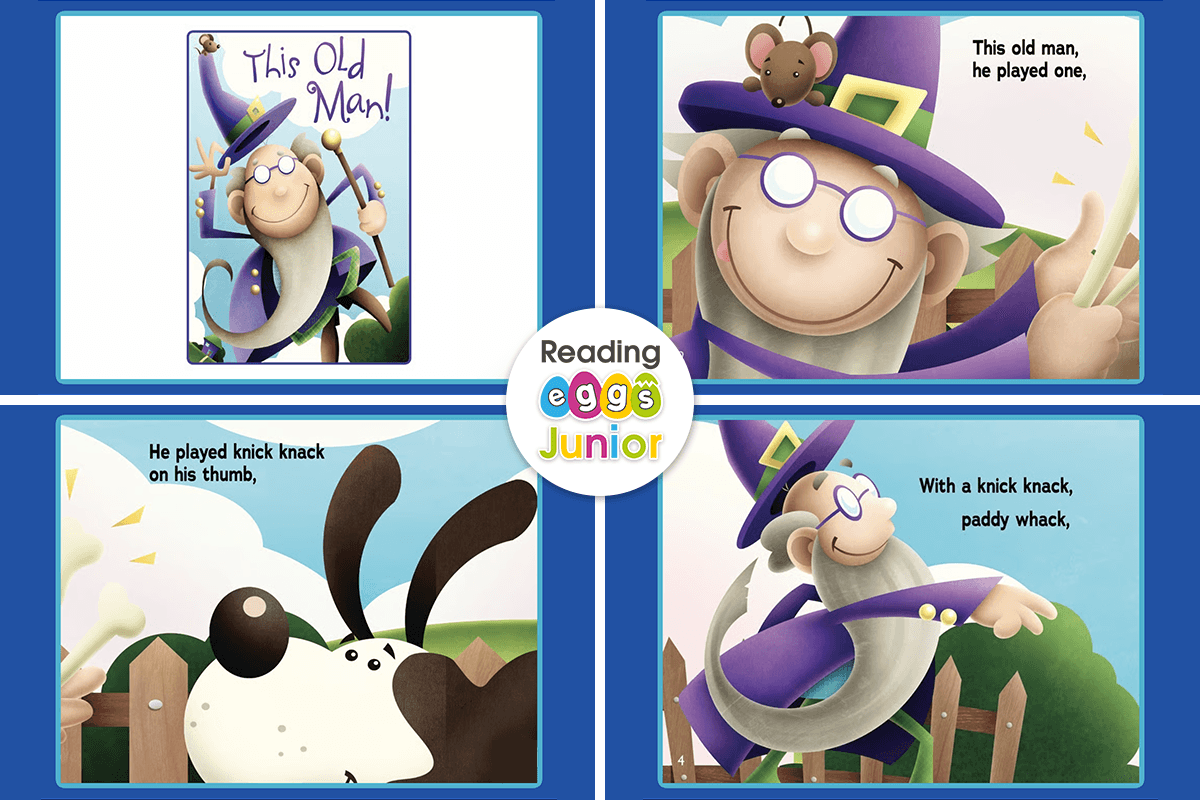
This Old Man is a fun nursery rhyme to clap along to with your child as each syllable is sung. You'll find This Old Man and other classic nursery rhymes in Reading Eggs Junior. Free trial
Phonemic awareness activities
These 20 fun activities help children develop phonemic awareness through play.
Whether your child is just beginning to isolate sounds (ages 4–5), learning to blend and segment (ages 5–6), or ready for advanced manipulation skills (ages 6–7), you'll find activities matched to their level.
Note: It's important that your child doesn't slip into a bad habit of guessing answers during the activities. In your instructions, make it clear that they need to ask for assistance if they don’t know an answer rather than resorting to a guess. At the start of each activity, tell your child: “If you aren't sure of an answer, say 'I need help'.”
Phoneme isolation activities (ages 4–5)
What is phoneme isolation?
Phoneme isolation is the ability to identify individual sounds in words – the first sound, last sound, or middle sound. This is the foundational phonemic awareness skill that all others build upon.
Activity 1: Sound Detectives
Goal: Your child can correctly identify the first sound in a word.
How to Play:
To start, put a hand up to your ear and tell your child, "It's time to put on your detective ears."
Say a word, emphasising the beginning sound (e.g. "Mmmmmm-onkey. What is the first sound you hear in monkey?").
Your child answers with the sound /m/. If they get it wrong, correct them and ask them for the first sound of another word.
Repeat any words they get wrong later in the game or the next time you play.
Tips:
Focus on sounds, not letter names; for example, say "with the sound /m/", rather than “with the letter M".
Start with continuous sounds like /m/, /s/, /f/ that can be drawn out to make it easier for your child to hear.
You can play this game when you're reading books aloud to your child, pausing the story to check in on their listening skills.
Variations:
As your child's isolation skills progress, increase the difficulty and ask them for the last or middle sound instead of the beginning.
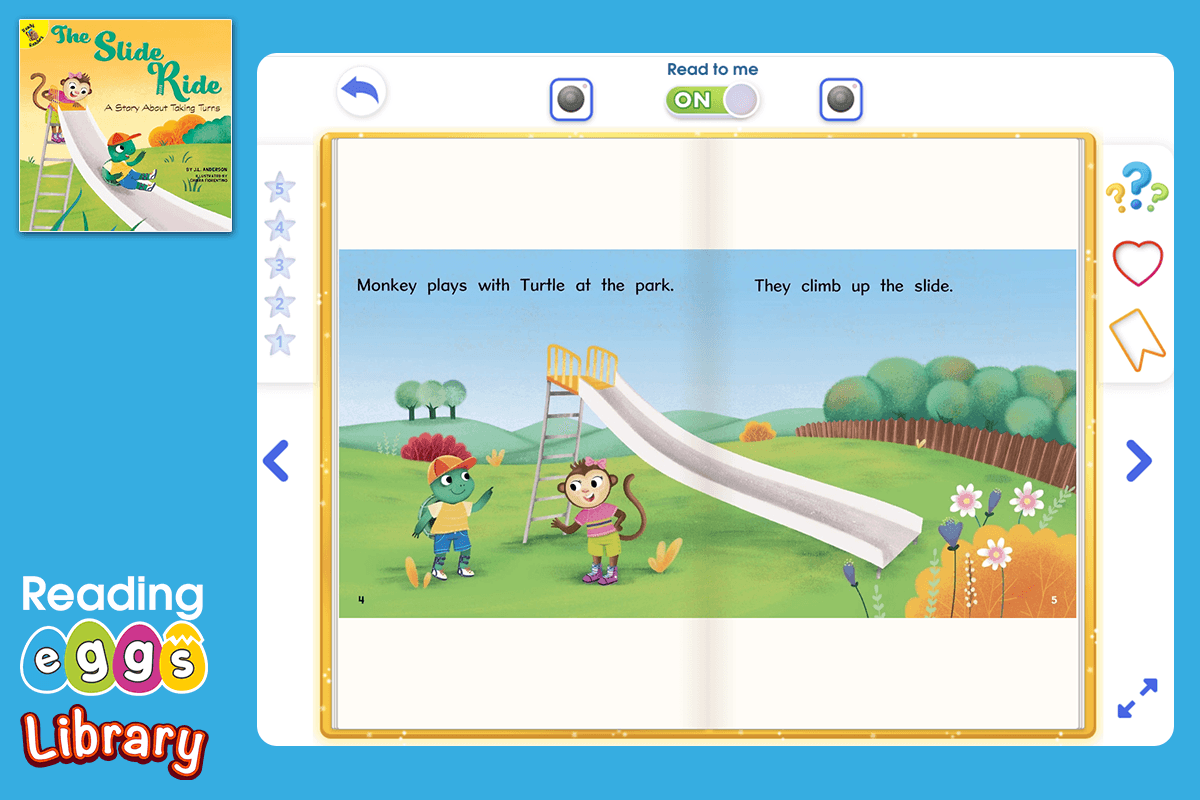
When reading books aloud to your child, pause the story and ask them to identify the beginning sound of a word. You can access hundreds of read-aloud books for kids in the Reading Eggs Library and in Reading Eggs Junior free for 30 days. Free trial
Activity 2: "I Spy" with Sounds
Goal: Your child can recognise objects that start with a specific sound (phoneme).
How to Play:
Say, "I spy with my little eye something that starts with the sound /b/..."
Your child scans the room and names possible items out loud (e.g., 'box', 'ball', 'basket', etc.).
Take turns being the one to guess.
Tips:
Focus on sounds, not letter names. For example, say "with the sound /b/", rather than “with the letter B".
Make sure there are sufficient items for your child to find! If you don't have enough objects around your house, try using printouts or pictures cut out from magazines.
Play in different environments to build your child's skills and vocabulary (e.g. in the car, while shopping, at the park, etc.).
Variations:
Use the Reading Eggs Alphabet I Spy printable with 23 pages of initial sounds. Each page contains eight familiar objects for your child to find.

Activity 3: Mystery Sound Box (or Bag)
Goal: Your child can name the initial sound of familiar objects.
What You'll Need:
3–5 objects from around your home (or picture cards).
A box or bag to hold the objects and conceal them from your child.
How to Play:
Ask your child to select an object from the box/bag and have them name it. Then ask your child to identify the object's initial sound.
Continue until there are no remaining objects in the box/bag.
If your child makes a mistake, correct them and include the object again next time you play. Repeat until they get it right.
Tips:
If using picture cards or magazine cutouts, laminate them or cover them in clear adhesive for durability.
Variations:
Progress to middle and ending sounds as your child's phonemic awareness develops
Use the Reading Eggs Initial Sounds printable to cut out picture cards and place them in the box/bag. There are four sets of cards with 136 pictures beginning with 24 different initial sounds. Start with only a few initial sounds and gradually increase the difficulty to include more sounds from a set.

Activity 4: First Sound Treasure Hunt
Goal: Your child can correctly identify items that begin with a specified sound.
What You'll Need:
A container or 'treasure box', such as a shoebox, basket or bag.
5–10 small objects or toys from around your house that start with only 2–3 different sounds (e.g. /b/ items: ball, button, block; /s/ items: sock, spoon, star).
Optional: Picture cards or magazine cutouts of familiar items.
How to Play:
Gather your “treasure” objects and place them in the treasure box.
Optional: use magazine cutouts or the picture cards in our Initial Sounds printable instead of physical objects.
Ask your child to find objects that begin with one of the 2–3 sounds.
Reward your child for each correct object they find.
Tips:
If using picture cards or magazine cutouts, laminate them or cover them in clear adhesive for durability.
Variations:
Make it more sensory and have your child search for treasure in a play tray of sand, uncooked rice or shredded paper instead of a box or bag.
Give your child sound clues and ask them to select an item from the treasure box based on those clues. For example, "I have something in the box. It starts with /b/. It's round. You can bounce it."
Have your child find objects around your home.
Hide objects around the yard and provide sound clues for a scavenger hunt.
As your child's isolation skills develop, increase the difficulty and add items beginning with a wider variety of sounds.
Progress to asking them to find objects based on the last or middle sound instead of the beginning.
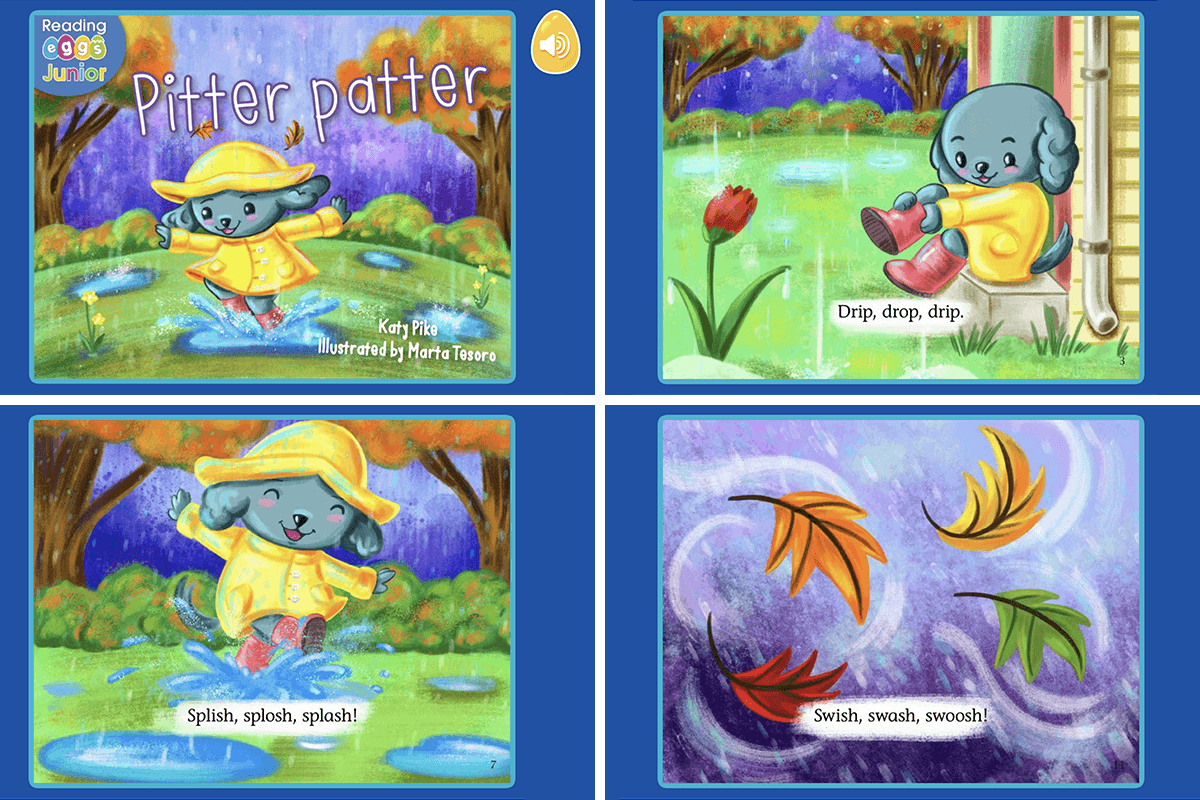
Build your child’s foundational phonemic awareness with hundreds of read-aloud books, interactive activities, funny videos and classic nursery rhymes in Reading Eggs Junior (ages 2–4). Free trial
Activity 5: Sound Sorting
Goal: Your child can sort and group items that begin with the same sound.
What You'll Need:
10 cards with simple pictures of objects, 3–5 of which start with the same target sound.
A small container to place the sorted cards in.
How to Play:
Lay the cards out on a flat surface, picture side up.
Ask your child to name the objects on all the cards and correct any they get wrong.
Tell your child: “This box is for objects beginning with …”
Ask them to find the cards that have objects beginning with the sound and to place those cards in the container.
If they choose an incorrect card, ask them to name the object again and the sound it starts with.
Variations:
You can use the picture cards from our Initial Sounds printable or the Alphabet Clip Cards printable.
Instead of cards, ask your child to sort toys or household items.
Progress to middle and ending sounds as your child's phonemic awareness develops.
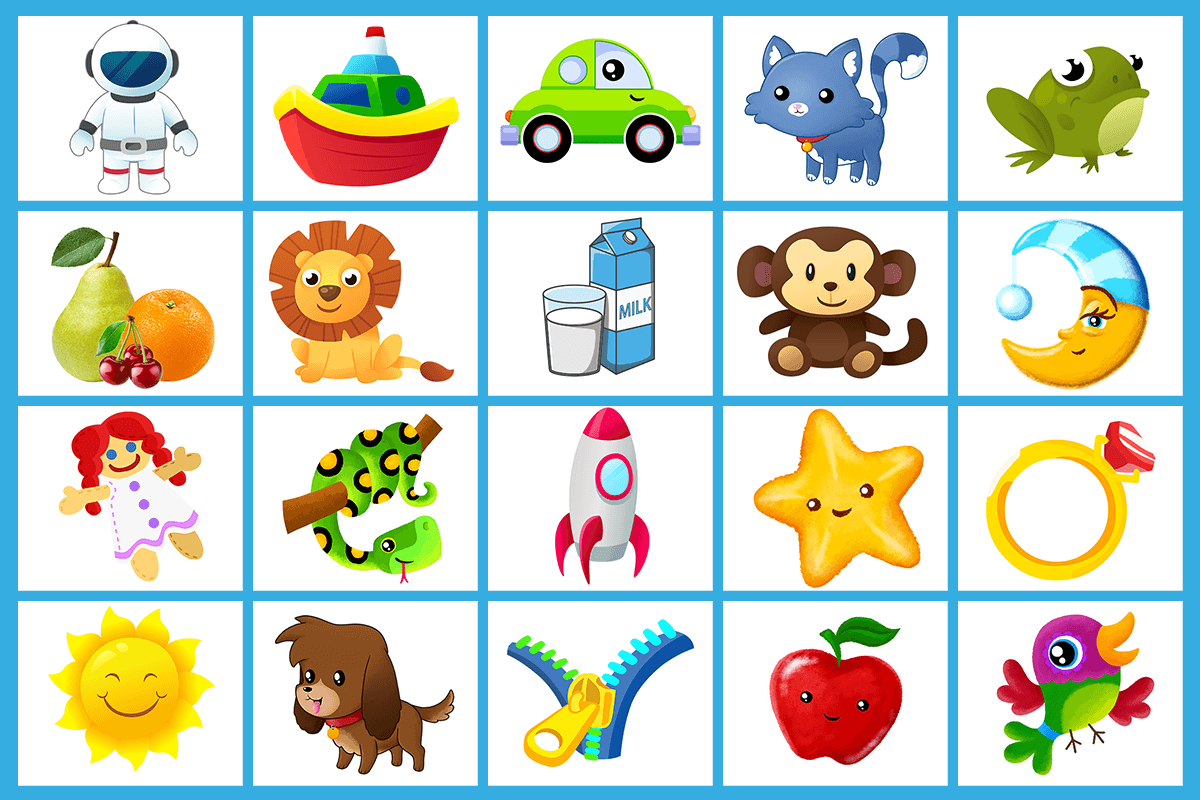
The picture cards from the Reading Eggs Junior Alphabet Clip Cards printables can be used for the Sound Sorting activity. Download these and other free printables from the Reading Eggs Junior website.
Activity 6: Pop-Up Sound Game
Goal: Your child can identify words that start with a specified phoneme.
What You'll Need:
You won't need any printed materials for this activity. However, you might like to have a list of relevant words to call out that start with your target sound, as well as some words that don't.
How to Play:
Start with your child sitting on a chair or on the sofa.
Choose your target sound (e.g. /b/).
Tell them: "You're a jack-in-the-box! When you hear a word that starts with /b/, jump up and shout 'POP!' If the word doesn't start with /b/, stay seated."
Say a word clearly and slowly – provide a mix of words that start with /b/ (ball, bus, bear) and words that don't (cat, dog, sun).
Your child will jump up for every /b/ word and stay seated for non-matching words.
Repeat any words they don't get right the first time.
Celebrate every correct 'POP!' with claps and cheers – make it theatrical.
Variations:
After 8–10 words, switch roles: your child says words, you are the jack-in-the-box.
Play the Jack in a Box activity in Reading Eggs Junior, an engaging online version of this game.
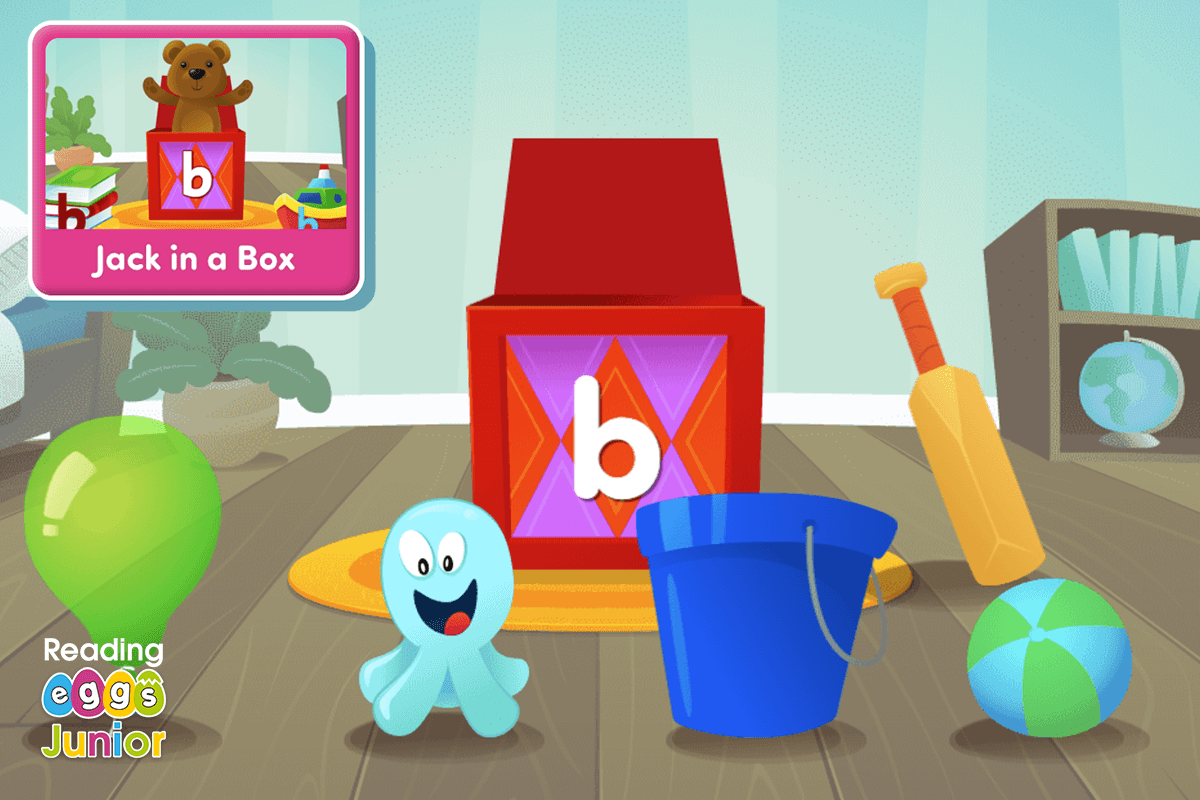
The Jack in a Box activity in Reading Eggs Junior is a fun way for children to practise sorting objects that begin with a target phoneme and to start recognising letters. Free trial
Phoneme blending activities (ages 5–6)
What is phoneme blending?
Phoneme blending is the ability to combine individual sounds together to form a complete word. For example, hearing /k/ /a/ /t/ and saying 'cat'. This blending skill is essential for reading – it's how children sound out written words when they start learning phonics.
Activity 7: Snail Talk
Goal: Your child can blend a sequence of stretched out sounds back together to identify the spoken word.
What You'll Need:
No materials are required.
Optional: Picture cards of familiar objects.
How to Play:
Tell your child you're going to talk very, very slowly like a snail and their task is to figure out what word you're saying.
If you're playing with a beginner, lay out three or four picture cards face-up so they have a visual set to choose from.
Choose a word and say it in Snail Talk, stretching out the sounds that can be stretched, like /m/ and /s/ (e.g. 'map' becomes “mmmmaaaap” and 'sun' becomes “ssssuuuunnnn").
Give your child a moment to think – encourage them to hold the answer in their head first before saying it aloud (we don't want them guessing).
Ask: "What word was that?"
Your child blends the sounds together and says the whole word at normal speed.
Confirm the answer, then switch roles – let your child be the snail and stretch a word out for you to guess.
Tips:
Focus on sounds, not letter names, and say “mmmmaaaap” as one continuous stretch, not "/m/ /a/ /p/" as separate beats (that's segmenting, not blending).
Words with continuous sounds like /f/, /s/, /m/, /n/, /l/ are the easiest to stretch – they can be drawn out without distortion, unlike stop sounds like /b/ or /p/ (notice how the /p/ in 'map' isn’t drawn out).
Start with three-sound words (sun, cup, map) before moving to four-sound words (lamp, jump, hand, left).
Exaggerate the snail persona – talk in a sluggish voice, make snail antennae with your pointer fingers – the sillier you are, the more engaged your child will be.
Variations:
A small set of picture cards showing simple objects your child is familiar with (e.g. sun, moon, cup, snake, book, frog) can be helpful for beginners when it's their turn to be the snail, such as the Reading Eggs Junior Alphabet Clip Cards.
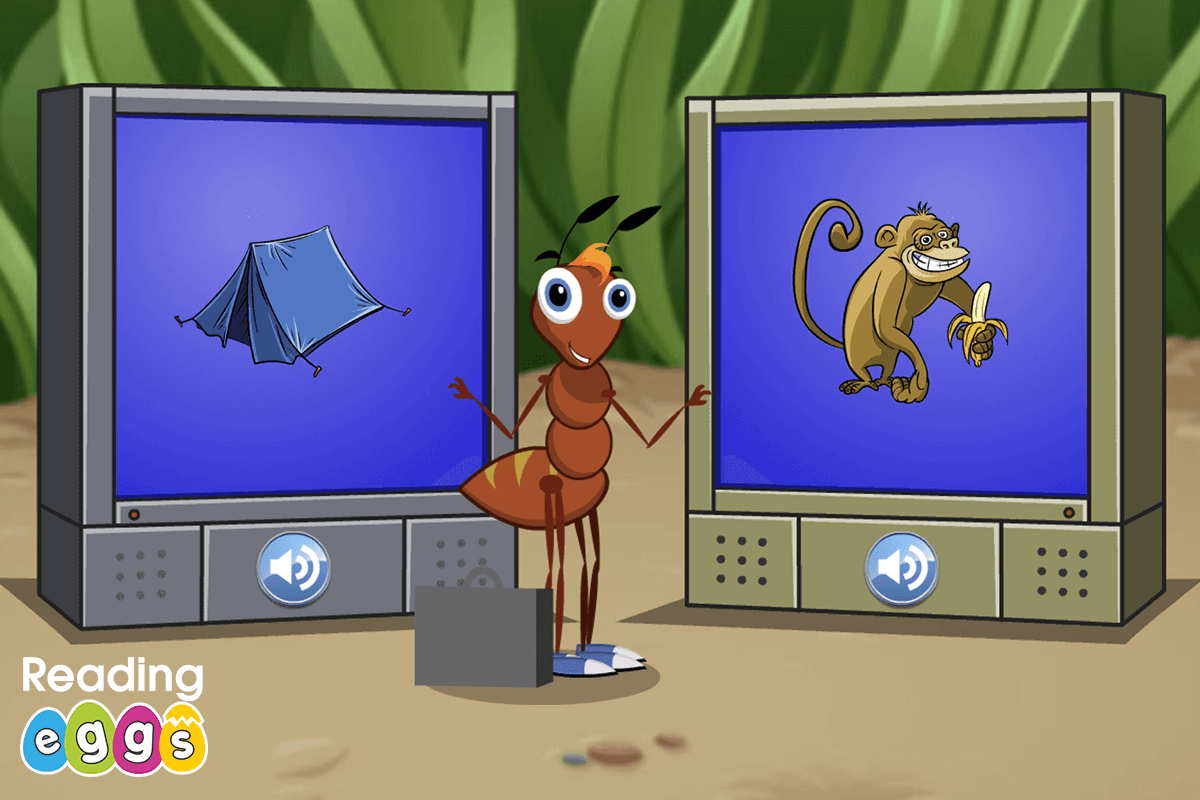
Reading Eggs teaches phonemic awareness using a sequential series of skill-building activities. From Lesson 1 your child will learn to recognise rhymes, listen to how sounds make words and begin mapping sounds to letters (phonics). Try Reading Eggs free for 30 days! Free trial
Activity 8: Bumper Cars Blending
Goal: Your child can blend two or three separate spoken sounds together to identify a whole word.
What You'll Need:
Two toy cars (or any two small toys your child loves – animals, dolls, trucks).
One small object to place in the middle (a block, a coin, a crayon – anything handy).
A flat surface like a table or the floor.
How to Play:
Place the two toy cars on either side of the centre object, let's say a block, with a large gap between them.
Tell your child: "These cars are going to help us build a word. Each car has a sound, and so does the block in the middle."
Assign a sound to each item. For the word 'map', the left car = /m/, the centre block = /a/ and the right car = /p/.
Say the left car's sound aloud as you slowly push it toward the centre object, stretching out the sound: "mmmm".
When it reaches the centre block, slowly say that sound: "aaaa".
Then push the right car toward the centre as you say its sound: "p".
Now ask your child: "What word do those sounds make?" (/m/ … /a/ … /p/ = 'map').
Once they've got the hang of the game and can sound out lots of familiar words, repeat with the cars moving faster – the quicker the movement, the more the sounds flow into each other, naturally modelling the fluency of blending.
Tips:
Model the activity yourself first before asking your child to try.
Focus on sounds, not letter names – say "mmmm" not "the letter M".
Begin with continuous sounds (sounds you can stretch out) like /m/, /s/, /f/, /n/, /l/ at the beginning of the word – these are much easier to blend than stop sounds like /b/, /p/ or /t/.
The speed of the cars matters – slow pushes for slow blending, fast pushes for fast blending; the physical rhythm is what makes the activity work.
Start with very slow pushes and drawn-out sounds (like in Snail Talk) then repeat the same word with faster and faster pushes until it sounds like natural speech – a great way to show what blending actually feels like.
Variations:
You can begin with two-sound words and omit the middle object before moving to three-sound CVC words (words with the consonant-vowel-consonant pattern such as 'sun', 'map', 'dog', 'cat', etc.).
Add a second centre object for four-phoneme words like 'lamp'.
Activity 9: Robot Talk
Goal: Your child can blend a sequence of separate spoken sounds together to identify a whole word.
What You'll Need:
No materials are required.
How to Play:
Tell your child: "I'm going to talk like a robot. Robots can only say one sound at a time – your job is to figure out my word! Remember, no guessing. Ask for my help if you don’t know the answer."
Say a simple word in robot talk, separating each sound with a short pause: "/k/ … /a/ … /t/. What's my word?"
Give your child a moment to think before answering.
Your child blends the sounds and calls out the whole word: "Cat!"
Confirm their answer: "Yes! /k/ /a/ /t/ makes 'cat'!"
If your child struggles, repeat the sounds a little more slowly and encourage them to say each sound along with you before putting them together.
Tips:
Focus on sounds, not spellings – say "/k/" not "the letter C".
Keep pauses between sounds consistent – about one second each – so your child learns to hold sounds in memory before blending.
Start with two-sound words, then gradually move to three- and four-sound words as your child's confidence builds.
Avoid words with consonant blends until your child's blending skills are more advanced.
Variations:
Action Words: Robot-talk an action word and have your child act it out once it's blended (e.g. “/s/ /i/ /t/”, “/h/ /o/ /p/”, "/j/ /u/ /m/ /p/" “/b/ /e/ /n/ /d/”, etc.).
Robot Fetch: Your robot child has a mission to fetch items for you. Say: "Robot, please fetch me a… /k/ /u/ /p/." When they bring you the item, ask them what it is. Be sure to scan the room before playing so you're only asking for objects that are actually within reach! When first starting, avoid words with consonant blends (e.g. plate, dish, spoon) and keep to simple words, such as pot, pen, bag, cap, lid, ball, box, etc.
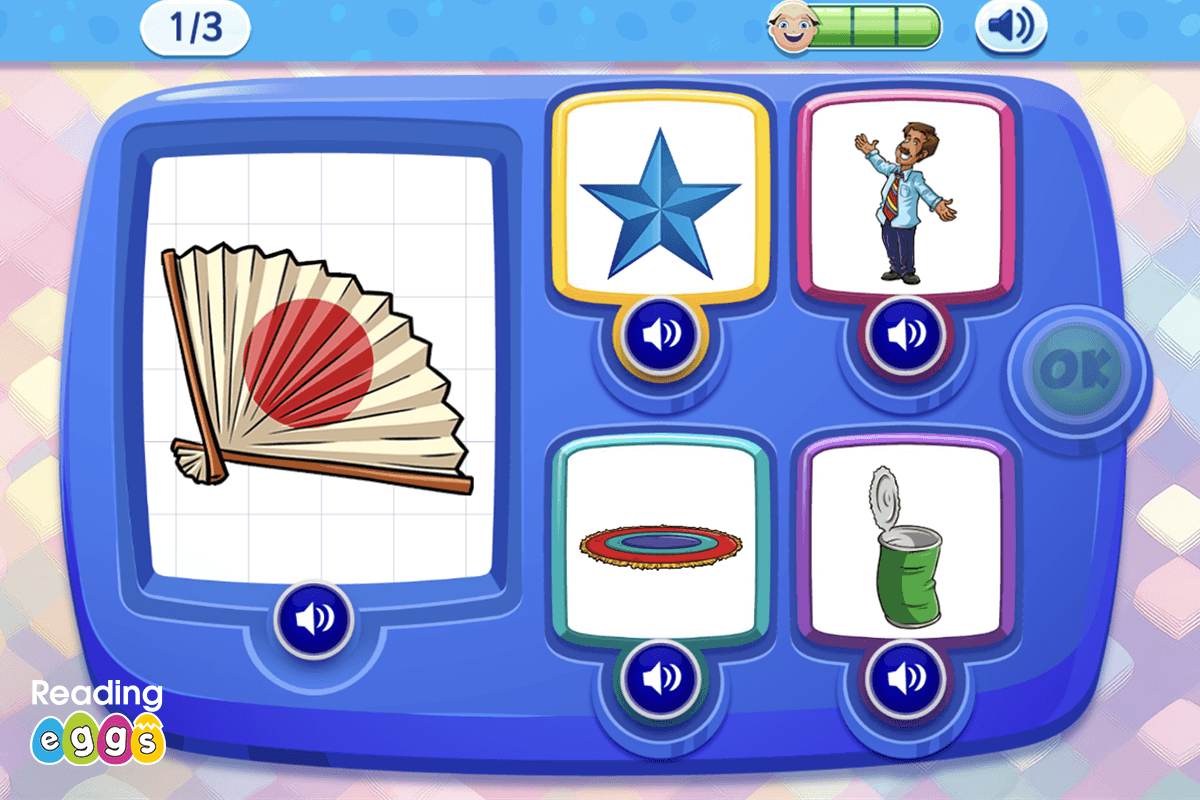
In Lesson 16 of Reading Eggs, children listen to words and select those that rhyme with ‘fan’ (i.e. ‘man’ and ‘can’). Try Reading Eggs free for 30 days! Free trial
Phoneme segmentation activities (ages 5–6)
What is phoneme segmentation?
Phoneme segmentation is the opposite of blending and involves breaking a spoken word into its individual sounds. For example, hearing 'cat' and identifying the three separate sounds: /k/ /a/ /t/. This skill is essential for spelling – it's how children learn to encode, or spell, words in writing. Many children find segmentation easier once they are comfortable blending sounds.
As children learn to segment spoken words into phonemes, they can begin to match those sounds to letters.
Activity 10: Finger Tapping Sounds
Goal: Your child can break a spoken word into its individual sounds by tapping one finger for each phoneme they hear.
What You'll Need:
No materials are required.
How to Play:
Hold up one hand with fingers relaxed and ready.
Tell your child: "We're going to break words into sounds. Each sound gets one finger tap."
Say a simple word aloud: "sun".
Ask: "How many sounds do you hear in 'sun'?"
Model it first – say the word slowly, tapping one finger on your left hand for each sound: "/s/" (tap index finger), "/u/" (tap middle finger), "/n/" (tap ring finger).
Count the taps together: "Three sounds! /s/ /u/ /n/. Now it’s your turn."
Your child copies you – says "sun … /s/ /u/ /n/" and taps three fingers.
Once they can copy confidently, ask them to try the next word independently before you model it.
Start with two-sound words, then move to three- and four-sound words as your child's confidence builds.
Tips:
Always model the activity yourself first before asking your child to try.
Focus on sounds, not letter names – say "/s/" not "the letter S".
Say the word naturally first, then slowly – this helps your child connect the normal spoken word with its segmented version.
Start with words that begin with continuous sounds like /m/, /s/, /f/, /n/, /l/ – these are easier to hold and hear clearly than stop sounds like /b/, /p/, or /t/.
Keep your tapping hand visible so your child can watch and copy – the visual model is just as important as the sound model.
If your child taps the wrong number of sounds, don't correct immediately – say “Let’s try it again.” Repeat the word together slowly one more time and tap along with them.
Variations:
Head, Shoulders, Knees: A large-motor version for children who need to move – touch your head for the first sound, shoulders for the middle sound, and knees for the last sound. Add more actions or use fewer, depending on how many sounds are in the word.
Activity 11: Sound Hopscotch
Goal: Your child can break a spoken word into its individual sounds by jumping once for each phoneme they hear.
What You’ll Need:
Enough space for a hopscotch grid, either inside or outside.
Chalk (for outside) or masking tape/painter’s tape (for inside).
How to Play:
Create a simple hopscotch path with three to five spaces in a row.
Tell your child: “We’re going to play Sound Hopscotch. We’ll jump for each sound in a word.”
Model the activity first – say a word slowly and jump once for each sound: “For example, ‘bed’…/b/” (jump), “/e/” (jump), “/d/” (jump).
Say the whole word again at the end: “bed!”
Then ask your child to try.
Say a new word and have your child jump once for each sound they hear as they say the sounds aloud.
Start with two-sound words, then move to three- and four-sound words as their confidence grows.
Tips:
Model the activity yourself first before asking your child to try.
Focus on sounds, not letter names — say “/b/” not “the letter B”.
Start with simple words your child already knows so they can focus on hearing the sounds rather than figuring out the word.
For beginners, say the word naturally first, then slowly as they jump – this helps connect the spoken word to its individual sounds.
If your child jumps the wrong number of times, say “Let’s try it again” and do the jumps together more slowly.
This activity works especially well for children who need movement to stay engaged.
Variations:
If they have the ability, your child can hop through the squares instead of jumping.
If hopping or jumping feels too tricky, your child can step, stomp, or march instead – one movement for each sound.
Harder: Move to four-sound words such as ‘hand’, ‘milk’, ‘jump’ or ‘left’ once three-sound words feel easy.
Advanced: After jumping the sounds, ask your child to do it again, this time counting how many sounds were in the word. Ask: “How many sounds did you jump?”
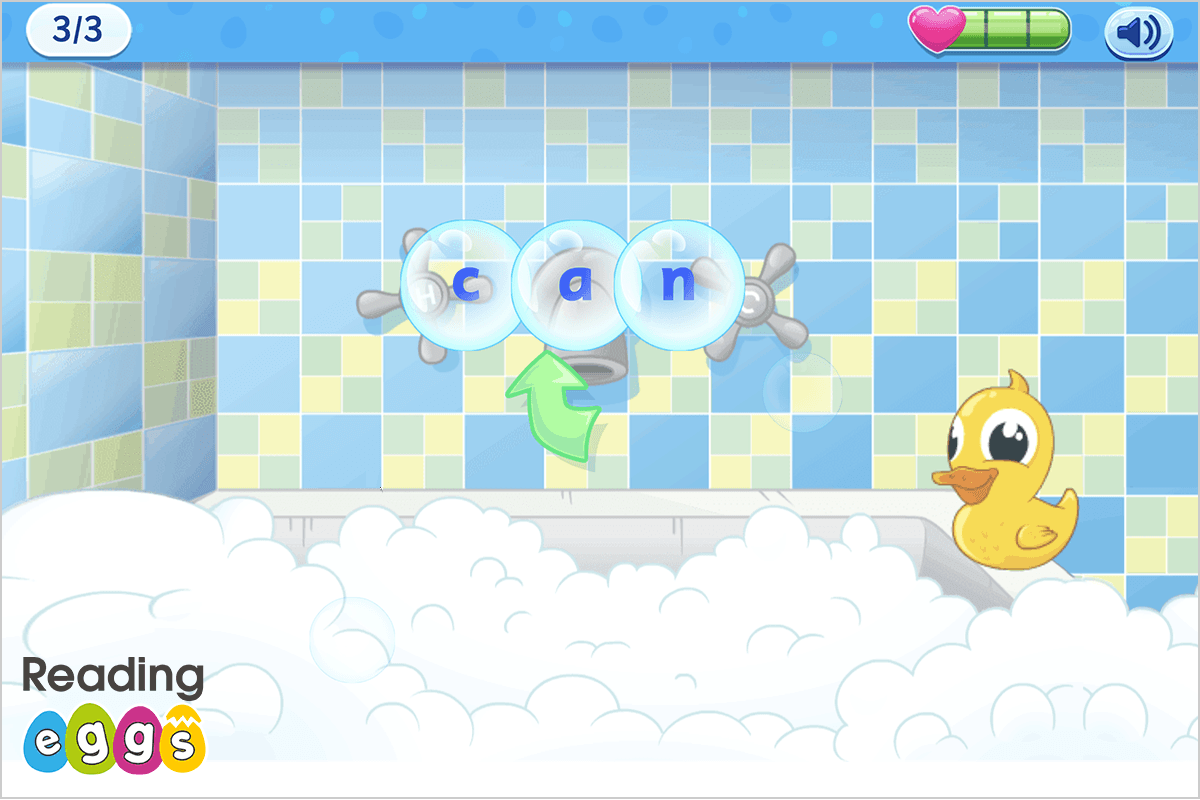
Reading Eggs teaches phonemic awareness and phonics using a sequential series of skill-building activities. Try Reading Eggs free for 30 days! Free trial
Activity 12: Pop-It Segmentation
Goal: Your child can break a spoken word into its individual sounds by popping one bubble for each phoneme they hear.
What You'll Need:
A Pop-It fidget toy (the silicone bubble toy) or a sheet of bubble wrap.
Or just your fingers if neither of those is available – tap one finger per sound instead.
How to Play:
Show your child the Pop-It toy and say: "Each sound gets one pop!"
Say a word aloud, e.g. "top".
Model it first – segment the word sound by sound, popping one bubble for each: "/t/" (pop), "/o/" (pop), "/p/" (pop).
Say the whole word and count together: "'Top' – three sounds!"
Flip the Pop-It over to reset the bubbles and try a new word.
Your child copies you – says the word, segments it and pops one bubble per sound.
If needed, model the activity a few times more before asking your child to try. Otherwise, have them pop sounds independently.
Tips:
Always model the activity yourself first before asking your child to try.
Focus on sounds, not letter names – say "/t/" not "the letter T".
This activity works especially well with short, sharp stop sounds like /p/, /t/, /b/, /d/, /k/, /g/ – the pop mirrors the sound perfectly.
Keep a steady rhythm – one pop per sound, not one pop per syllable.
If your child pops the wrong number of bubbles, say "Let's try it again" and segment the word together slowly.
Activity 13: Sound Boxes with Chips (Elkonin Boxes)
Elkonin boxes are a multi-modal experience. Your child can hear, see, and touch the individual sounds in a word. Whereas in previous activities the sounds were mostly auditory, Elkonin boxes take something abstract and make it concrete (children 'see' the sounds).
Goal: Your child can break a spoken word into its individual sounds by sliding one chip into a box for each phoneme they hear.
What You'll Need:
A sheet of paper.
A pen or pencil.
Small objects to use as markers – coins, flat round buttons, game chips, checkers, blocks or Lego pieces all work well.
How to Play:
Draw five boxes in a row on your piece of paper: ☐ ☐ ☐ ☐ ☐.
Place a small pile of markers within easy reach of your child.
Tell them: “We're going to play a game using these markers. I'll say a word and I want you to listen for the sounds in it. Place one marker in a box for each sound you hear. Watch me first.”
Say a word aloud: "map".
Slowly say each sound and slide one marker into a box for each sound: "/m/" (slide marker into first box), "/a/" (slide marker into second box), "/p/" (slide marker into third box).
Point to each marker in turn and say the sounds: "/m/ … /a/ … /p/".
Sweep your finger across all three boxes and say the whole word: "map!".
Then it’s your child's turn – say a new word and ask them to slide the markers as they say the sounds.
Tips:
Model the activity yourself before asking your child to try.
Focus on sounds, not letter names – say "/m/" not "the letter M".
Create a laminated template of the sound boxes sheet for repeated play.
If your child slides the wrong number of markers, say "Let's try it again" and work through the word together slowly, sliding markers in unison.
If they repeatedly struggle, draw the exact number of sound boxes in each word on a new sheet of paper for a few turns until they get the hang of it.
Variations:
Coloured Markers (advanced): Use two different colours – one for the sounds at the beginning and end of a word, and one for the sound in the middle. Can your child hear which sound sits in the centre?
Letter Boxes (advanced): Write a letter in each box after placing the markers – a natural bridge from pure sound work into phonics when your child is ready.
This is a great bridging activity between phonemic awareness and beginning phonics instruction. Once your child can segment words correctly using markers, introduce the Letter Boxes variation, connecting each sound to its written form. From there, your child can begin decoding written words – one of the most important milestones in early literacy.
Watch: How to teach phonics
Watch our video below with tips from Reading Eggs literacy expert, Sara Leman, on how to teach your child to read with phonics.
Phoneme manipulation activities (ages 6–7)
What is phonemic manipulation?
Phonemic manipulation is the ability to change a word by adding, removing or swapping one of its sounds to create a new word. For example, removing the /b/ from 'bat' leaves 'at', adding /m/ to the front of 'at' makes 'mat', and swapping /b/ for /s/ makes 'sat'. These three operations – addition, deletion, and substitution – are the most cognitively demanding phonemic awareness skills.
Before trying the following phonemic manipulation activities, make sure your child can confidently isolate and segment the phonemes in simple three-sound words. Repeat the activities in the previous sections until they can.
A gentle bridge into phoneme manipulation is playing with word families and changing the beginning sound while keeping the ending the same. Spend some time exploring common word families like -at, -an, -ap, and -am with your child (words like 'cat', 'bat', 'mat', 'ran', 'can', 'fan', etc.).
Once children can hear that 'bat', 'mat', and 'sat' all share the same ending sound, they are primed for manipulation – because the ending (the 'rime') stays constant and only the beginning sound (the 'onset') changes. This approach simplifies the task, allowing them to focus on one specific sound change at a time.
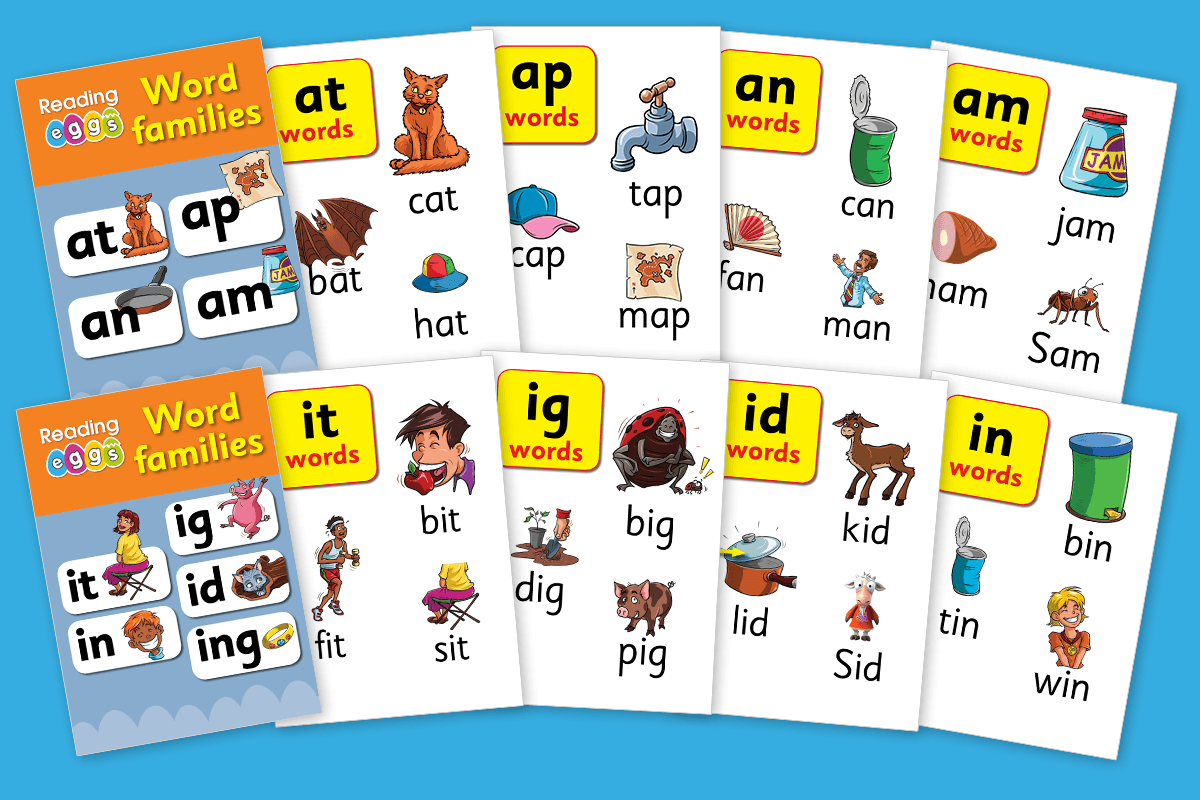
You can download free word families printables (and 500+ worksheets) with a Reading Eggs free trial or subscription. The Lesson 42 and Lesson 49 Homeschool Worksheets (downloadable from the Bonus Materials > Activity Sheets menu in the Family Dashboard) contain booklets of simple CVC words that are great for practising phoneme manipulation. Start your 30-day free trial today!
Activity 14: Rhyme Time Chains
Goal: Your child can produce rhyming words by changing the beginning sound while keeping the ending sound the same.
What You'll Need:
A ball or small cornhole beanbag to toss.
How to Play:
Stand opposite your child, holding the ball or beanbag.
Say: “Let's make a rhyme chain! Each time we catch the ball, we have to say a word that rhymes by keeping the ending the same and changing the first sound. A word can't be repeated, but made-up words are OK. Our first word is 'cat'.”
Throw the ball or beanbag to your child.
Your child calls out a new rhyming word, for example: “bat!” and throws it back to you.
You catch the ball and say another rhyming word.
Continue taking turns until a player 'drops' the ball by running out of rhyming words.
The winning player gets to choose a new word family for the next round.
Tips:
Start with common word families that have lots of easy rhymes, such as -at, -an, -ap, -ig, and -op.
Explain the pattern if your child gets stuck: “We're keeping the -at part and only changing the beginning sound.”
Accept nonsense words if they truly rhyme.
Keep the game fast and playful rather than stopping too long to correct mistakes.
If a word is repeated, gently remind your child: “That one's already been used – can you think of another?”
For beginners, stay with one word family for the whole round before switching to a new one.
Variations:
Elimination Game: If you can't think of a rhyme in 5 seconds, you're out.
Silly Sentence: Make silly sentences with your rhyme chain words.
Count Your Rhymes: See how many rhymes you made in one word family: “We made 10 rhymes in the -at family!”
Speed Round: Set a timer and see how many rhymes you can make in 60 seconds.
Activity 15: Karate Chop Sounds
Goal: Your child can delete a sound from a spoken word to make a new word.
What You'll Need:
No materials are required.
Optional: A foam pool noodle for a bigger, more satisfying chop.
How to Play:
Tell your child: "We're going to karate chop sounds away from words – are you ready? Hi-yah!" (make a karate chopping action with your hand).
Hold one of your hands out flat like a platform and say: "This hand is our word."
Say a word aloud: e.g. "bat".
Say: "Let's chop away the /b/ sound – hi-yah!" and bring your other hand down in a karate chop motion over your outstretched hand.
After the chop, ask: "What's left?"
Your child answers: "at!"
Confirm together: "That's right – 'bat' without the /b/ is 'at'!"
Try a new word, letting your child do the chopping this time.
Tips:
Model the activity yourself first before asking your child to try.
Focus on sounds, not letter names – say "/b/" not "the letter B".
Start with deleting first sounds, then gradually introduce deleting the last sound once that becomes easy.
Encourage enthusiastic karate sound effects – the sillier the better – as it keeps young children engaged.
Always confirm the correct answer together after the chop, so your child hears the target word part clearly.
Variations:
Noodle Version: Use a foam pool noodle to slice through the air and a cushion as the flat platform – a bigger motor movement that works especially well for children who learn through physical activity.
Create a storyline: "Our ninja needs to sneak past the guard by chopping the first sound off the password. The password is 'mat'. What does the ninja say?" – the narrative gives the deletion task a purpose that keeps children invested.
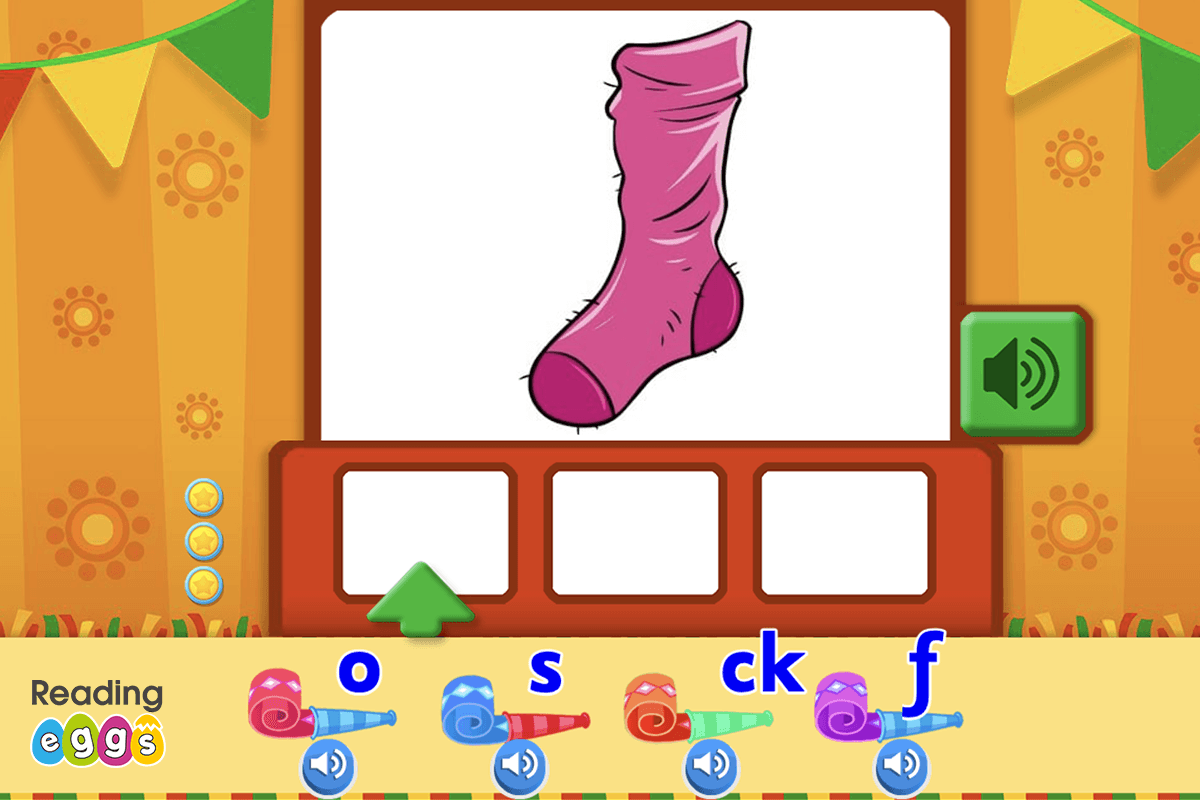
In Lesson 60 of Reading Eggs, children learn to segment words such as 'sock'. Try Reading Eggs free for 30 days! Free trial
Activity 16: Block Removal
Goal: Your child can delete a sound from a spoken word to make a new word.
What You'll Need:
Three to five building blocks – wooden blocks, Lego or Duplo all work well.
A flat surface to build on.
How to Play:
Place your blocks on the table in front of you and tell your child: "Each block is a sound in a word."
Point to each block in turn and say the sounds: "/f/ … /i/ … /n/ – fin!"
Say: "Let's take away the /f/ sound – which block should we remove?"
Your child removes the first block.
Point to the remaining two blocks together: "/i/ … /n/ – in!"
Confirm: "Fin without the /f/ is 'in' – well done!"
Rebuild the row of blocks with a new word and repeat.
Once your child is confident, let them build the row of blocks themselves and tell you which block to remove – shifting the control to them deepens engagement.
Tips:
Focus on sounds, not letter names – say "/f/" not "the letter F".
Start with removing the first block – deleting the first sound is the easiest deletion task and builds confidence before attempting middle or final sound removal.
Keep the remaining blocks in position after removal so your child can see and point to what is left – the visual layout reinforces the concept that removing a sound changes the word (even if it's a nonsense word).
If your child removes the wrong block, rebuild the row together and slowly say each sound again while pointing to each block in turn.
Variations:
Easier: Use just two blocks for simple two-sound words ('at', 'up', 'it') – removing one block leaves a single sound, which is the simplest possible deletion task.
Harder: Move to four-block words (hand, milk, jump, left) and vary which block is removed – beginning, middle, or end – once first-sound deletion from three-sound words feels easy.
Similar to Sound Boxes (Elkonin boxes), this activity is multi-sensory and helps make abstract sounds something physical children can see.
Activity 17: Build-a-Word Blocks
This activity is similar to the Block Removal activity, except this time your child will be adding sounds instead of removing them.
Goal: Your child can add or change a sound to make a new word.
What You'll Need:
Three to five building blocks – wooden blocks, Lego or Duplo all work well.
A flat surface to build on.
How to Play:
Place your blocks on the table in front of you and tell your child: “We're going to play a game with these blocks. Each block stands for a sound. When we add a new sound, we add a new block.”
Place one block in front of your child: "This block is the sound /a/."
Say: "Let's add the /t/ sound to the end."
Place a second block next to the first and say: "This block is /t/."
Point to both blocks and join them together (blending): "/a/ … /t/ – at!"
Say: "Now let's add /m/ to the beginning."
Place a third block in front and say: "This block is /m/."
Point to all three blocks and blend: "/m/ … /a/ … /t/ – mat. We built the word 'mat'!"
Swap the first block for a new one: "Let's swap /m/ for /s/."
Point to all three blocks and blend: "/s/ … /a/ … /t/ – sat!"
Work through several onset (beginning) sounds with the same rime before moving on to another word family.
Tips:
Focus on sounds, not letter names – say "/m/" not "the letter M".
Always blend after each addition so your child hears how the new sound changes the word.
Variations:
Easier: Start with just two blocks – add one sound to a single sound ("/a/ plus /t/ = at") before moving to three-sound words.
Harder: Move to four-sound words (hand, milk, jump, left) once three-sound words feel easy.
Onset and Rime: Use a longer block to represent the rime and a shorter block for each onset (beginning sound) – place the long block on the table and say "This is 'at'", then swap shorter blocks at the front to build 'mat', 'sat', 'bat', 'hat', etc.; the size difference makes it immediately visible that the rime stays constant while the onset changes.
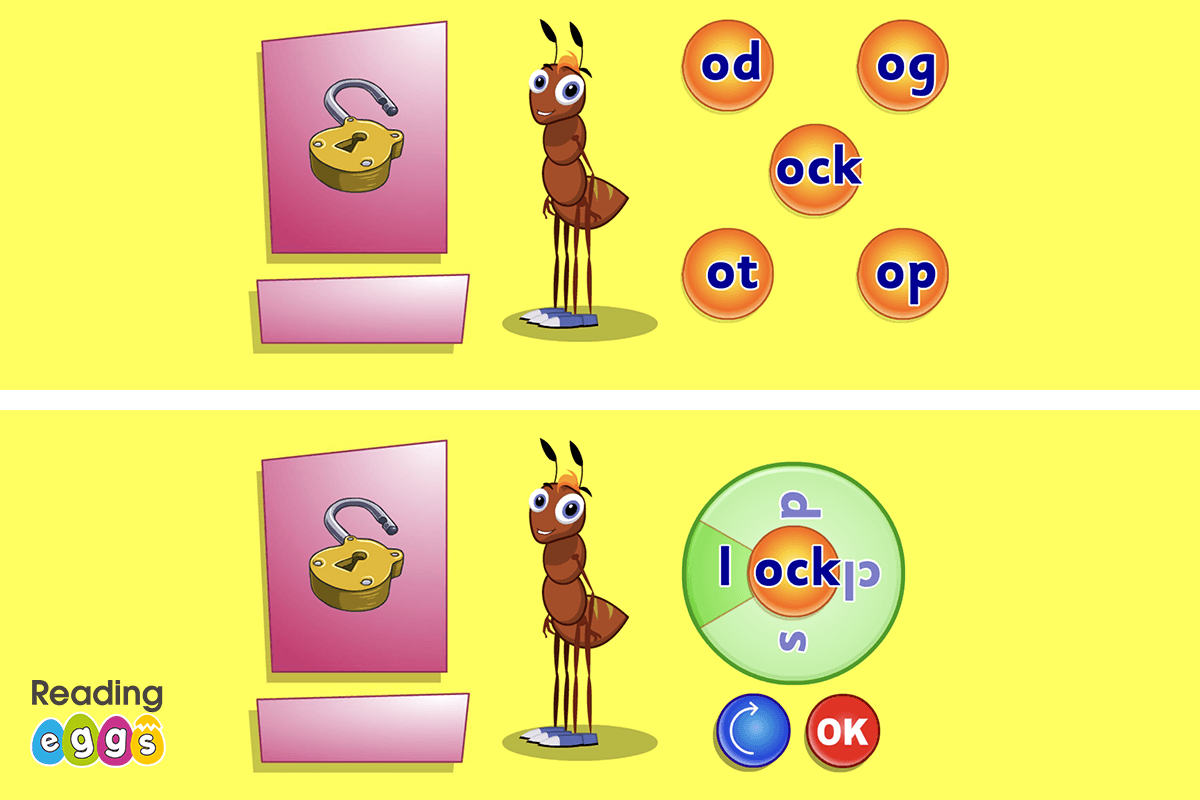
Reading Eggs teaches children how to read using a sequential series of skill-building activities. In Lesson 60, children learn to identify the rime (ock) and then the onset (l) in the word 'lock'. Start your 30-day free trial today!
Activity 18: Magic Sound Swap
Goal: Your child can change one sound in a spoken word to make a new word.
What You'll Need:
A toy magic wand (or get creative with a stick, pencil or kitchen utensil).
Three to five empty vessels – plastic cups or small cardboard boxes are ideal.
A flat surface to play on.
Optional: Extra magician props, such as a cape.
How to Play:
Place three of the empty vessels (for three-sound words) in a row on the table and tell your child: "I'm a magician. Watch me turn one word into another with magic sound swaps."
Wave your 'magic wand' and say: "Abracadabra! I'm changing cat into bat."
Ask: "Which sound did I swap?"
Your child points to the first vessel and responds: "/k/ changed to /b/!"
Pick up the changed vessel and say: "Yes! I swapped /k/ for /b/ to make 'bat'!"
Take turns with your child being the magician.
Tips:
Focus on sounds, not letter names – say "/b/" not "the letter B".
Always pick up the container representing the changed sound to reinforce the visual connection.
Make it dramatic – add silly magic words, gestures and sound effects.
Progress from beginning sounds to ending sounds and then middle sounds (vowels).
Variations:
Harder: Move to four-sound words (hand, milk, jump, left) once three-sound words feel easy.
Activity 19: Where Did the Sound Change?
Goal: Your child can listen to two similar words, identify which sound changed, and tell whether the change happened at the beginning, middle or end of the word.
What You'll Need:
No materials are required.
How to Play:
Tell your child: "I'm going to say two words. Listen carefully and tell me where the sound changed – at the beginning, middle, or end."
Say two words that differ by just one sound: "cat ... bat"
Ask: "Where did the sound change?"
Your child answers: "Beginning!"
Then ask: "Which sound changed?"
Your child answers: "/k/ changed to /b/!"
Confirm: "Exactly – the beginning sound changed from /k/ to /b/."
Try another pair: "bag ... big"
Your child answers: "Middle! /a/ changed to /i/!"
Continue with more pairs, working through beginning, middle and end changes in random order to prevent guessing.
Once your child is confident, let them say two words for you to analyse.
Tips:
Start with beginning sound changes, as these are usually easiest for children to hear.
Middle sound changes can often be the hardest to hear.
Focus on sounds, not letter names — say /k/ and /b/, not C (as in 'letter C') or B (as in 'letter B').
Say both words clearly, with a small pause between them, so your child has time to compare the difference.
If your child is unsure, repeat the pair more slowly.
Keep the word pairs simple and familiar so the listening task stays focused on sounds, not vocabulary.
Variations:
Sorting Game: Use three cups or boxes labelled Beginning, Middle and End. Say a word pair aloud and ask your child to place a counter or small object into the correct container. This adds a visual element without introducing letters.
Phonics Bridge: Show the two words with magnetic letters or letter tiles after your child has identified the sound change by ear. This helps them connect the sound change to the printed word.
Activity 20: Sticky Sound Chains
Goal: Your child can build a chain of new words by changing one sound at a time.
What You'll Need:
Post-it notes (or small squares of paper and Blu Tack/tape).
A flat surface such as a table, wall, window or floor.
How to Play:
Place three Post-it notes in a row and tell your child: “We're going to make a sound chain. Each sticky note represents one sound in a word.”
Say a starting word: “For example, sun.”
Then tap each Post-it as you say the individual sounds: “/s/ … /u/ … /n/ – sun!”
Tell your child: “Now we're going to change just one sound to make a new word. Let’s change /s/ to /f/.”
Peel off the first Post-it and replace it with a new one to show that the first sound has changed.
Tap the three Post-its again and blend: “/f/ … /u/ … /n/ – fun!”
Continue the chain, changing one sound at a time.
Once your child understands the pattern, let them suggest the next sound change in the chain.
Tips:
Focus on sounds, not letter names — say “change /s/ to /f/” rather than “change S” (as in letter S) “to F” (as in letter F).
Start with short, three-sound words your child is familiar with.
Begin with initial sound changes, then ending sounds and finally, middle sounds, which are usually the hardest.
If your child gets stuck, offer some alternative word choices: “Should we change sun to bun instead? Or how about run?”.
Variations:
Phonics Bridge: Once your child can do the activity confidently by sound, write the matching letter or grapheme on each Post-it after the oral swap. For example, after changing /k/ to /b/, write 'c, a, t' on the three Post-it notes, then change the first note to 'b' to make 'bat'. This helps your child connect the sound change to print.
Magnetic Tile Extension: If you have magnetic letters or tiles, rebuild the same sound chain with them after completing it orally.
Fun phonemic awareness activities online!
Reading Eggs features hundreds of fun and interactive online lessons that build essential phonemic awareness and phonics skills. Based on scientific research, the program has been shown to increase children's reading skills in just 15 minutes a day.
Tips for making phonemic awareness activities fun
Phonemic awareness activities are most effective when they are short, playful, multi-sensory and built into everyday life. Young children usually learn sound skills best through quick, engaging games rather than long, formal lessons.
A good rule of thumb is this: if your child is smiling, moving and successfully listening to sounds, the activity is working. Keep it brief, keep it playful and stop while your child is still enjoying it.
Keep sessions short: Aim for short practice sessions of around 5–15 minutes. This helps your child stay focused and keeps the activity feeling light and successful rather than tiring or repetitive. It is better to do a few minutes of sound play regularly than one long session that leads to frustration.
Make it playful: Children are more likely to engage when activities feel like games. Use silly voices, toy props, movement, guessing games, treasure hunts or pretend play to keep the mood light. Activities with game-like formats work well because they turn listening to sounds into something fun and memorable.
Use multi-sensory approaches: Phonemic awareness is easier for many children when they can hear, see, and move at the same time. Try activities that include tapping, jumping, moving counters, sliding markers, or using simple objects such as blocks, chips or sticky notes. Visual and physical supports like manipulatives and hand motions are widely recommended because they help make abstract sounds more concrete.
Incorporate activities into daily routines: You do not need a formal lesson every time. Phonemic awareness can be practised naturally during everyday moments – in the car, at bath time, while getting dressed, during snack preparation or when tidying up toys. Embedding sound play into routines helps children see language learning as part of normal life.
Frequently asked questions about phonemic awareness
What is a phoneme?
A phoneme is the smallest unit of sound in a spoken word. For example, the words 'bat' and 'mat' differ by just one phoneme: /b/ and /m/. Phonemes are sounds, not letters.
How long should phonemic awareness activities last?
Keep phonemic awareness activities short – 5 to 15 minutes daily is ideal. Research shows frequent, short sessions are more effective than longer, less frequent practice.
At what age should children start learning phonemic awareness?
Begin phonological awareness activities (rhyming, syllables) as early as ages 2–3. Phonemic awareness activities (isolating individual sounds) typically start around ages 4–5 (preschool/reception) when children are developmentally ready.
Can phonemic awareness activities be done at home?
Yes! Many of the best phonemic awareness activities require no materials and can be done anywhere – in the car, during bath time, while cooking. Activities like “I Spy” with Sounds and Sound Detective are perfect for home practice.
What materials do I need for phonemic awareness activities?
Most phonemic awareness activities are oral and require no materials. However, simple manipulatives such as blocks and counters can help make abstract sound concepts more concrete for young children. You can even use small toys and household items to make the activities more fun, playful and multi-sensory.
How do phonemic awareness activities help with reading?
Phonemic awareness activities help children understand that words are made of individual sounds. This supports later decoding (sounding out words), encoding (spelling) and orthographic mapping as children begin learning how sounds connect to letters.
What's the difference between phonological and phonemic awareness activities?
Phonological awareness activities work with larger sound units (words, syllables, rhymes). Examples: clapping syllables, finding rhyming words. Phonemic awareness activities focus specifically on individual phonemes (the smallest sound units). Examples: identifying the /k/ sound in 'cat', blending /k/ /a/ /t/ to say 'cat'. Phonemic awareness is a subset of phonological awareness and is the most advanced level.
How long does it take to develop phonemic awareness?
With regular practice, many children make noticeable progress over months rather than weeks, but the pace varies widely.
My child struggles with phonemic awareness. What should I do?
First, make sure the activities match your child's current skill level. If your child struggles with blending, go back to simpler listening and sound-isolation activities. If segmentation is difficult, spend more time on blending first. Simple manipulatives such as blocks or counters can help make abstract sounds more concrete. Keep sessions short, positive, and playful, and stop before frustration sets in. Try to weave sound games into everyday routines so practice feels natural and low-pressure.
With regular practice, many children improve over time. If you remain concerned, consider speaking with an early childhood educator, speech pathologist or other trusted professional for further advice.
Can older children (ages 7–10) benefit from phonemic awareness activities?
Absolutely! If older children missed phonemic awareness instruction or are struggling with reading, these activities can help close important foundational gaps. Use age-appropriate framing (avoid 'baby' activities) and consider Fast Phonics (for ages 5–10), which reinforces phonemic awareness alongside phonics instruction.
Fun phonemic awareness activities online!
Reading Eggs features hundreds of fun and interactive online lessons that build essential phonemic awareness and phonics skills. Based on scientific research, the program has been shown to increase children's reading skills in just 15 minutes a day.

You might also like


Discover Topics

